Greetings!
I certainly hope you are reading aloud to your students. It is my belief that we should read aloud to students of ALL ages. Yes, I know that older students can read for themselves and you high school teachers or librarians probably don’t read aloud to them. Still, I think you should. Here are my reasons.
1. Everyone enjoys a good story and we should not leave anyone out. I know that I listen to a preacher better if the sermon is illustrated with stories.
2. Speaking of listening, many children today need to improve listening skills and stories are one way to help improve that skill.
3. Reading aloud and sharing books models how important this skill is. When I read a book to a group, the book I read is the exact book that students ask for over and over. Years ago I read a story called “Mailing May” (see note below) to a group of 1st and 2nd graders. One little girl checked the book out repeatedly for years. She graduated last year, but that book was special to her for many years.
You may not realize what kind of power you have at your fingertips. You can influence the reading material of your students. There is such a plethora of reading material and much of it is just trash. If we can find good wholesome books for our kids to read, what a blessing it would be.
I hope you have a great week.
Audrey
Note: Mailing May by Michael O. Tunnell, Illustrated by Ted Rand. Greenwillow Books, 1997.
Summary: May is a small child who wants to go visit her grandmother across the Idaho mountains, but the family does not have enough money to pay the $1.55 fare. May tries to earn money, but she is just too young. However, Ma and Pa come up with a plan. Ma’s cousin Leonard is working on the mail train from Grangeville to Lewiston and May is ‘mailed’ to her grandmother. What is the best thing about this book is that the story is true. You can read the whole story in the back of the book.
Check out other books by Michael O, Tunnell if you like this one.
Tuesday, September 18, 2012

Monday, September 10, 2012
Greetings!
Since the school year has just started, you have money that needs to be spent on your school library. I’ll be happy to help you spend this.
Throughout the school year I will give you ideas for books that you may either need or want for your library. This week I have some great ones for you.
If your library is like many libraries, you need to update your astronomy section.
Here is a great one titled A Black Hole is Not a Hole by Carolyn Cinami DeCristofano published by Charlesbridge. She does a great job of explaining what a black hole really is. The book is just about right for elementary libraries. Students from middle to upper grades will all be able to read and learn from it. Teachers can use it as a great supplemental resource for science, too.

Since election time is right around the corner, putting out some books about elections, governments, and presidents will help stimulate some interest in the subject. Here is a set of books from Searchlight Books published by Lerner about Judges and Courts, The Congress, and The President, Vice President, and Cabinet. These are appropriate for primary and middle grades.

I found a set of books that address certain issues that come up at school such as being kind and honest with others. This set is called Positive Steps published by Smart Apple Media and each book in the set addresses a particular kind of behavior. The titles shown are Dealing with Differences, Being Honest, Caring for Others, and Dealing with Bullying.

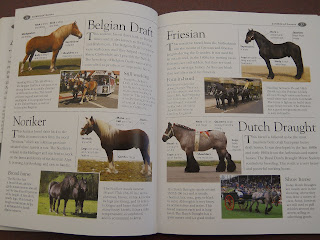
If you have horse lovers in your school like I have at mine, you can’t have enough horse books. Kingfisher Riding Club is a reputable source for all things horse and this one about the different breeds from around the world is really great. I learned that there are hot-blooded, warm-blooded, and cold-blooded horses. Who knew?! Read Horse and Pony Breeds by Sandy Ransford to learn more.

Last week I answered a question about outdated textbooks and asked for any suggestions from you regarding them. Jennifer H. responded with some great options. She said that older math and reading textbooks can be used as a resource for extra practice. You can sell them at yard sales. Student missionaries who will be teaching may welcome them. Contact the WWU student missions to see if there is any interest for them. Thanks, Jennifer, for your great ideas.
I hope you got some good ideas for books.
Have a great week.
Audrey
Since the school year has just started, you have money that needs to be spent on your school library. I’ll be happy to help you spend this.
Throughout the school year I will give you ideas for books that you may either need or want for your library. This week I have some great ones for you.
If your library is like many libraries, you need to update your astronomy section.
Here is a great one titled A Black Hole is Not a Hole by Carolyn Cinami DeCristofano published by Charlesbridge. She does a great job of explaining what a black hole really is. The book is just about right for elementary libraries. Students from middle to upper grades will all be able to read and learn from it. Teachers can use it as a great supplemental resource for science, too.

Since election time is right around the corner, putting out some books about elections, governments, and presidents will help stimulate some interest in the subject. Here is a set of books from Searchlight Books published by Lerner about Judges and Courts, The Congress, and The President, Vice President, and Cabinet. These are appropriate for primary and middle grades.

I found a set of books that address certain issues that come up at school such as being kind and honest with others. This set is called Positive Steps published by Smart Apple Media and each book in the set addresses a particular kind of behavior. The titles shown are Dealing with Differences, Being Honest, Caring for Others, and Dealing with Bullying.

If you have horse lovers in your school like I have at mine, you can’t have enough horse books. Kingfisher Riding Club is a reputable source for all things horse and this one about the different breeds from around the world is really great. I learned that there are hot-blooded, warm-blooded, and cold-blooded horses. Who knew?! Read Horse and Pony Breeds by Sandy Ransford to learn more.


Last week I answered a question about outdated textbooks and asked for any suggestions from you regarding them. Jennifer H. responded with some great options. She said that older math and reading textbooks can be used as a resource for extra practice. You can sell them at yard sales. Student missionaries who will be teaching may welcome them. Contact the WWU student missions to see if there is any interest for them. Thanks, Jennifer, for your great ideas.
I hope you got some good ideas for books.
Have a great week.
Audrey
Tuesday, September 4, 2012
Outdated Textbooks
I got an email from a teacher wondering what I tell people to do with outdated textbooks. She wondered what the best way is to take care of them and wondered if there was a place that needed them.
This is a great question. I am not sure what people do with them actually. I know that most schools simply do not have the storage space to keep them. I would say that if they are in poor condition, to recycle them if possible. If they are in good condition, I would expect that there are schools somewhere that could use them. I don’t know where to find these schools, but I think that the conference office may know more about this than I do.
If the old books are from the old reading series, I would recommend keeping a set or two of each level in the library as a library book. It may be that you have students who need more reading practice and having a book that is on his or her level to read will really help. This is especially true for the younger grades. If you have any of the old Dick and Jane books or even the really old Alice and Jerry books, you have a treasure. Keep them in the library and let students check them out to read.
Now I will turn the tables on to my readers. What do YOU recommend schools do with outdated textbooks? I’ll compile ideas and let you know what others suggest.
I hope you have a great week and a Happy New School Year!
Audrey
Wednesday, May 30, 2012
Summer Plans
Greetings!
This week has been so hectic that it only just occurred to me that I had not sent a post this week! I am sure that many of you are in the same situation and maybe did not even notice that you didn’t have an email from me! This summer as you are working or thinking about next year, send me any questions or ideas you may have for my weekly posts.
If you are moving and no longer wish to be on my list, please send me an email to that effect and I will take your name off the list.
If you are moving, but want to continue to receive posts, do nothing. If you have a new email and wish to have the posts sent to that email, please let me know.
If you have an interest in organizing your library or just want to get some ideas, come to one or both of my sessions at the NAD convention in August. I’ll be giving one on “How to Organize a Small Library” and another called “ShopTalk for Librarians”. You don’t have to be a ‘librarian’ to come to these. The Shop Talk session will be discussions about subjects you bring up or want to talk about. Never fear. I have plenty to talk about, but it’s more fun if it is a discussion rather than me talking on and on for an hour.
I look forward to seeing you in August. I hope to actually meet some of you rather than just know you by name and email! Have a great summer! Audrey
Monday, May 21, 2012
Library Policies
Greetings!
If you have thought about making a change in your library procedures, this is the perfect time to do something about it. You can decide what you want done differently next year and write up the procedures you want to change or include so you are ready for a new year next August.
This last year I tried something new at my library. In the past I have limited students to three books each check out period. Special circumstances would allow four books. This year I threw caution to the wine and decided to let students in third grade and above check out as many books as they wanted. During their first library class I asked them how many books they had been able to check out last year, then I said that this year we were going to try something different. They could check out as many books as they could be responsible for. I gave several scenarios to help explain what I meant about being responsible for books. The students were thrilled and have done very well with this new plan. Here I am at the end of the school year and I have about the same number of books that are lost or damaged as I had previously. I count our experiment this year as a success. This did not apply to the lower grade students. Students in first and second grade still were limited to two books and Kindergarteners to one book. I have talked before about policies and encouraged you to have some of these in place. If you don’t have these in place, I strongly encourage you to do so.
This is also a good time to plan for next year so you are ready to put policies in place. You should have a policy for selection of library materials. Who chooses books for the library? What criteria do you use for selection? What do you do if a parent challenges material in the library? Do you have community patrons? Do you let the church members check out from your library? I can hear some of you saying to yourself, “We’re a very small school. We don’t need those policies at our school.” It is my belief that ALL schools need these policies. I believe it is better to have a plan or policy in place BEFORE we need it rather than afterwards. Having policies ahead of time also keeps us from appearing to target a particular individual. No one can point to any individual and claim that it is a specific individual’s fault. No, it is just our policy. If you are a very small school and you feel you need support, consider having the Board help establish these or vote them in. What policies do you need? You need a selection policy (a statement of how materials are chosen to be placed in your library and how they will be removed), and a reconsideration policy (a statement of what the procedure will be in the event someone challenges some material in your library.) You might want a policy for community patrons, homeschoolers, or church members that might choose to use your library. I tell the community patrons that they are welcome to check out books, but if a teacher or students needs the particular item they have, I will ask them to return it right away. I have only had to do this one time, but my policy was in place and the patron was very cooperative. You can look up sample policies on the internet or contact me and I will send you our policies to help you draft your own. I hope this has been helpful to you. This is not something that is fun to do, but one of those necessary items. Once it is done, then just check it every few years and update it as needed. Have a great week! Audrey
Tuesday, May 15, 2012
Summer Library
Greetings!
School is winding down quickly. Soon it will be summer. Do your students read over the summer? Where are they getting their books? Do you have a public library in your town for them to use? If you don’t have these resources for your students to read, what are they going to do?
At my school we open up the library for a few hours once a week in July. We call it Summer Library. We do this for a few reasons. Our school is located in College Place and many of our families live in College Place. The public library is in Walla Walla. College Place residents must pay a large yearly fee to use the Walla Walla Public Library, and very few are willing and able to do this.
Another reason we open our library is simply because a number of families prefer our more conservative collection over the public library’s collection. The public library has some wonderful books, but most parents do not have the knowledge of children’s literature to make appropriate choices for their children and it can be overwhelming. It is much easier and less stress to come to our school library and check out.
A third reason we open the library is that I have an assistant who is willing to be here on those days and operate Summer Library. We have a few students who come with their families on a regular basis, but when no one is in the library, we can get a lot of work done.
What about you? Is this something that might happen at your school? Maybe this is not an option at all for you. But many teachers do go work at school in the summer. If you do, would you be willing to be at school on a particular day each week and let students come in to check out?
I have no idea if this idea would work for you, but I thought I would give you something to think about. Holding Summer Library may sound good, but not be feasible for you. Here are some other ideas.
1. Consider making a summer reading list. Parents can easily find the books at the public library and may even check out books for themselves while they are there.
2. Challenge students to read a certain number of books over the summer, or to read a certain number of minutes a day. Provide reading logs for them.
3. Hold a book swap so students can get ‘new’ reading material for summer reading. This is really pretty easy and also FREE.
4. Send out a weekly email to your families with book ideas and reading activities for summer. Maybe you can sneak in a few fun math challenges, too!
I hope some of these ideas sound interesting to you. If you are interested in holding a Book Swap, you can get more information on the internet, or go to my blog – sdalibrarian.blogspot.com – and you will find a post or two (March 2010 and January 2011) about Book Swaps.
Have a great week.
Audrey
Monday, May 7, 2012
New Books
Greetings!
I found a wonderful book that you will want to purchase for your library. It is called “If You Lived Here: Houses of the World” by Giles Laroche, published by Houghton Mifflin Books for Children 2011. The illustrations are done in cut paper relief which gives shadows and a three dimensional feel to the pages. Each two page spread is on a different type of house that people live in. There is text to explain the type of home, and below is smaller text to give more information about the type of house, the materials used for building it, the location of the home and other interesting facts about the house. One fascinating fact about cave dwellers is that children growing up in villages with cave dwellings believe everyone lives in caves and are surprised to learn that most people live in houses with four walls and roofs! You might be as surprised as I was to learn that there are 45 million people living in caves today and they are often quite modern in their interiors.
 The kinds of houses we learn about in this book include dog trot log house, mountain chalet, pueblo, connected barn, cave dwelling, palafitos (houses on stilts), Venetian palace, chateau (looks like a castle with a moat), Fujian tulou, half-timbered town houses, whitewashed village in Greek islands, decorated houses in Ndebele, South Africa, yurt, Airstream trailer, floating house, and tree house. The back page has a blank map of the world depicting where the different houses are located.
Do you have students who are interested in nature and love to learn about it? What if they could be part of a scientific experiment and contribute to scientific studies? How cool is that? “Citizen Scientists” by Loree Griffin Burns, published by Henry Holt and Company 2012 is a book that explains how citizens are already helping scientists and how you can get involved. Four different activities are described, one for each season. Fall Butterflying, Winter Birding, Spring Frogging, and Summer Ladybugging. The last six pages are resources for more information. This book will excite the nature lover and even be interesting to indoor types.
 If you teach about the body and particularly the heart, one new book is called “Henry’s Heart” by Charise Mericle Harper published by Christy Ottaviano Books, a division of Henry Holt and Company. The illustrations are drawings that are a little childish, but still attractive. A lot of information about the heart is given in a fun way. When Henry runs, the heart beats faster, and slows down when he slows down. Henry’s heart even falls in love – with a puppy! On each page there is the main text and other thought and conversation bubbles to read.
 I hope you enjoy these books. I really love finding new books and am happy to pass them on to you. I love my job!
Have a great week.
Audrey


Subscribe to:
Posts (Atom)