Hello,
I have some things that you might be interested in, but they don’t really go together. The only thing they have in common is that they are both new to me!
One is a website that has information, activities and cool things to do in respect to climate. I looked over the Carbon Travels section and did notice one place that mentions ‘millions of years ago’, but the information is updated and interesting. At first I thought the site was for young children since it is brightly colored and has font that is somewhat juvenile, but it looks like it will work for grades 3 – 8. The review on Common Sense Media says Grades 3 – 6. There is a lot of reading, so children will need to be able to read fairly well or work with a partner.
Subjects include Weather and Climate, Air, Ocean, Fresh Water, Carbon’s Travels, Energy, Plants and Animals, Technology and Big Questions. Big Questions discusses “What is ‘global climate change?”, “What is the Greenhouse Effect?”, What is happening in the ocean?”, “What else do we need to find out?”, “What is the big deal with carbon?”, “How do we know the climate is changing?”, and “What can we do to help?”
http://climatekids.nasa.gov/
The other is a book about a few people who helped establish our National Parks. My husband and I are ‘collecting’ National Parks, and when I saw a preview of this book, I requested a galley to look it over.
The title is Mountain Chef: How One Man Lost His Groceries, Changed His Plans, and Helped Cook Up the National Park Service by Annette Bay Pimentel. It is the true story of Tie Sing, a Chinese American mountain man who fed thirty people for ten days in the wilderness. He was hired by Stephen Mather to cook for his group of influential men on this camping trip hoping to influence them to help create our National Parks. Tie Sing planned diligently, but he could not know that problems with the donkeys carrying the food would happen causing Tie to completely change his menus not once but twice. Tie creatively made fortune cookies on the last night with fortunes reading “Long may you search the mountains” or Long may you build the paths through the mountains” and more. This is a picture book with watercolor paintings throughout. At the end is more information including photos of the people on the camping trip plus little bios of some of the men. If you visit Yosemite National Park, you can hike to Sing Peak which is named for Tie Sing.
Look for this book coming out on August 2, 2016. It is a great tribute to the 100th anniversary of the National Park Service created by Congress on August 25, 1916.
Have a great week!
Audrey
Currently reading:
A New Song by Jan Karon (Book 5 of the Mitford series)
The Indiscretions of Archie by P. G. Wodehouse
The Year of Living Danishly by Helen Russell (Audible book)
It Ain’t So Awful, Falafel by Firoozeh Dumas
Monday, April 18, 2016

Monday, April 11, 2016
Book Talks
Hello,
I have a group of students that seem to think checking books out of our school library is not cool enough. They want to go to the public library to get their books. This past week, I decided to do some book talks for them during their library class. I found 6 – 8 books in our library that were age appropriate and interesting. I realized that I really did not have enough time to write book talks for all of those books before their class time, so I did the next best thing. I went to the internet and typed in the title of each book and the term ‘book talk’. I found a couple of great sites and printed out the book talks for each book.
I typically use Amazon.com to check out information about books and this is a good place to start. Amazon has summaries of the books and if needed they can be tweaked slightly to make a good book talk. http://www.amazon.com/
One site was Teen Ink. This is a literary magazine for teens and teens write the book reviews. I used one review from this site. If you decide to use this site, read the review and make sure that it is a good fit for your school. https://www.teenink.com/reviews/book_reviews/
My best source the other day was a site that I use personally – GoodReads.com Their reviews/book summaries worked very well for me. https://www.goodreads.com/
In searching for book reviews sources today, I came across some by children on SchoolTube. If you aren’t familiar with SchoolTube, I understand that it is YouTube for scholastic purposes. The ones that I saw were by children and were quite short, so you could show quite a few of them in a short time. I also had the thought that students might decide to create their own book talks and post them. You can also find book talks on YouTube. http://www.schooltube.com/search/?term=book+talks
Scholastic has book talks for their books, too. Each book fair that we host here has a resource section where tons of information and help can be found. Book talks are there, too. You just print out the ones you need. Even if you don’t host Scholastic book fairs, you can type in Scholastic book talks and find them. http://www.scholastic.com/teacher/ab/booktalks.htm; http://teacher.scholastic.com/products/tradebooks/booktalks.htm#discussion
If you wish to either teach students how to prepare their own book talks or make it a bit easier to create them yourself, ALA (American Library Association) has a lesson plan plus template and even a rubric for this purpose. http://www.ala.org/aasl/sites/ala.org.aasl/files/content/conferencesandevents/ecollab/lpd/StudentCreatedBookTalks.pdf
By the way, after I gave the book talks, those students came rushing to my table to grab the books I had just promoted. I felt pretty good about that.
Have a great week!
Audrey
PS. For each book talk I used, I copied the source at the bottom of the review both to cite it and to remember where I got it from.
Currently Reading:
A New Song by Jan Karon (Book 5 of the Mitford series)
Gunn’s Golden Rules by Tim Gunn
The Indiscretions of Archie by P. G. Wodehouse
The Year of Living Danishly by Helen Russell (Audible book)
Monday, April 4, 2016
New Books
Hello,
Here are a few new books you might like.
Tree of Wonder by Kate Messner, illustrated by Simona Mulazzani. This is a book about a tree in the rainforest and the creatures that make their homes in the tree. The book begins with 1 Almendro tree, 2 Great Green Macaws, 4 Keel-billed Toucans, and continues multiplying 8 more times. In the back is more information and websites about the Almendro tree and extra rainforest math problems. One of the problems is this: There are four Great Green Macaws shown in the illustration on pages 4 – 5. When the eggs hatch, how many birds will there be all together? There are also book suggestions and a movie suggestion for more rainforest information.


I chose the poison dart frog page because they are so colorful and I wanted you to see the visual of 256 frogs in the sidebar. I also like that there is easier text and more informational text. Great for a reading buddy situation.
Beatrix Potter and Her Paint Box by David McPhail. A simple biography of the author/illustrator of Peter Rabbit plus many other books for children. Beatrix Potter was born nearly 150 years ago this coming July and her books still remain popular. McPhail has used watercolors to illustrate this book which is a lovely nod to Beatrix’s own illustrations.


Traveling Butterflies by Susumu Shingu. If you study the life cycle of a monarch butterfly, this is a great resource to have. The book begins with a picture of eggs on a leaf, and continues through the different stages of a butterfly through their migration south.


Edible Science Experiments You Can Eat by Jodi Wheeler-Toppen and Carol Tennant. If your kids like science experiments and eating, they will enjoy this book. Each experiment give the science of what is happening. There is a list of supplies needed, a difficulty level, time needed, and instructions. Vocabulary words may be found on many pages. Photographs help to show some of the steps in each experiment and children are shown wearing lab coats and goggles when appropriate.


Clean Sweep! Frank Zamboni’s Ice Machine by Monica Kulling, illustrated by Renné Benoit. Here is the story in picture book format of the Zamboni ice machine and how it came to be invented. Use this in a unit on inventors, the Winter Olympics, ice skating, or just for fun. There are a list of fun facts at the end of the book. One of the is that a Zamboni machine, with a top speed of 9 miles per hour, was driven across Canada from St. John’s, Newfoundland to Victoria, British Columbia, a trip that took four months.


The last set of books I want to share with you today is actually three books that work well together. In a preview box, I found among other things, three different sets of books. One set had six biographies written on a low reading level. The series is found under the title “Amazing Inventors & Innovators. The books in that series include George Eastman, Alexander Graham Bell, Thomas Edison, Henry Ford, Samuel Morse, and The Wright Brothers.
Another set of books was titles Amazing super Simple Inventions and each one has projects for children to do. Super Simple Aircraft Projects, Super Simple, Automobile Projects, Camera Projects, Phonograph Projects, Telegraph Projects, and Telephone Projects. One of our 5th and 6th grade teachers was interested in these projects.
The third set of books was about inventions. Aircraft, automobiles, cameras, phonograph, telegraphs, and telephones.
I admit that it took me a while to realize that the three sets were linked to each other. They would make great units. Read the biography of George Eastman, read about the invention of the camera, and then have your class do some or all of the camera projects. The books have different authors, but the publisher is ABDO. I do wish the publisher would have combined these three books into one and published six books rather than eighteen, but apparently they didn’t think to ask me.


I hope you see something that interests you. Have a great week.
Audrey
Currently reading:
A New Song by Jan Karon (Book 5 of the Mitford series)
The Blue Castle by L. M. Montgomery
Gunn’s Golden Rules by Tim Gunn
Monday, March 28, 2016
Display Ideas
Hello,
When you walk into a library, how do you feel? Do you feel calm, comforted to see so many books and know that there is much to choose from or do you feel intimidated and just grab something quickly or even turn around and walk out? I always loved to see so many books available and felt at peace when walking into a library. I was excited to see what they had in THIS library that other libraries I had been into might not have had. However, many children actually are intimidated by so many books to choose from. What can we do to help these children?
One of the best ways to help children is to make smaller displays regularly of books that they might find interesting, or displays to support your curriculum. When children see displays that are attractive, they are drawn to them and it is much easier to choose a book from a small sample than to try to find the same book on a big shelf. You can also take the time to walk around with a child and help them find the books they want or need.
As children get older, you can start teaching them to use the card catalog (if you still have one) or the computer to find the subject or title they want. Believe it or not, they don’t automatically know how to do this and need to be taught.
I am getting ready to take down a display we had of our Iditarod books we put up in early March. I’m planning three more displays to have in the library and my display case. One will be on Earth Day, one will be on Robotics, and one will be to celebrate Beverly Cleary’s 100th birthday coming on April 12. You can show a very recent clip from ‘Good Morning America’ to your students or find others to show. Check out YouTube for other ideas to promote Beverly Cleary and her books.
I hope you had a great spring vacation.
Audrey
Currently reading:
Anna and the Swallow Man by Gavriel Savit
A New Song by Jan Karon (Book 5 of the Mitford series)
Jane of Lantern Hill by L. M. Montgomery
Monday, March 14, 2016
Biographies
Hello!
What does your biography section look like? Do you have a lot of the Childhood of Famous Americans series and not much else? Are they beat up and unattractive?
Check out the biography section and see what grade levels are represented. When you study science, make sure you have science biographies. Some schools have large sports biography sections. It can be hard to know WHO to put in the biography section. Here are some guidelines and then some suggestions.
Guideline 1: Make sure you have a number of presidents of the United States represented. I would hope that most (if not all) of them are represented.
Guideline 2: Check that there are biographies on all reading levels, even beginning readers.
Guideline 3: Look for biographies on people who are good role models and who will be known throughout the years. Think about Malala, Mother Teresa, Mark Zuckerman, Bill Gates, etc. It may be that your community has someone who is important. There might be a biography written about them.
Guideline 4: Sports people are fine, but many of them are short term as far as popularity goes. If you have a lot of sports biographies, you may need to weed often and purchase often to keep it updated.
Guideline 5: There are sets of Christian biographies that focus on Christian leaders. We put the Trailblazer series in our biography section. Also look for the Heroes of the Faith series. The ones we have in our library are white with a maroon strip at the top. People included in this set are John Bunyan, Fanny Crosby, Jim Elliot, Billy Graham, C. S. Lewis, David Livingstone, Martin Luther, D. L. Moody, Samuel Morris, John Newton, Charles Spurgeon, Corrie ten Boom, Mother Teresa, Sojourner Truth, and John Wesley. There are more, but this list will give you some ideas of what the series is like.
Guideline 6: Check to see if you have biographies on Ellen G. White. There may also be biographies on other SDA leaders to include, too.
Suggestions: If you need to update your lower reading level biographies, I would urge you to consider a set we have gotten this year. Brad Meltzer has begun to write biographies for young readers. He started writing them after going to the store with his young daughter and finding lots of ‘princess’ shirts and clothing. He began to wonder where the strong women role models were for his daughter. When he didn’t see what he wanted, he began to write them. His series is titled “Ordinary People Change the World”. Titles so far are “I Am Amelia Earhart, I am Lucille Ball, I am Abraham Lincoln, I am Rosa Parks, I am Albert Einstein, I am Jackie Robinson, I am Helen Keller, and I am Martin Luther King, Jr.” Coming next September will be “I am George Washington, and I am Jane Goodall.” The illustrations are cartoonish and there are speech bubbles in the text, but the information is solid and our first and second graders love them. I have also given them to lower readers in third and even fourth grade.


Another set we got is published by Scholastic and is called Rookie Biographies.


I hope you enjoy your biographies and consider updating them from time to time.
Have a great Spring Vacation!
Audrey
Currently reading:
The Indiscretions of Archie by P. G. Wodehouse
The Millionaires by Brad Meltzer
Anna and the Swallow Man by Gavriel Savit
These High, Green Hills by Jan Karon (Book 3 of the Mitford series)
Monday, March 7, 2016
Ideas to Promote Use of the Library
Hello!
A few years ago I found some ideas for encouraging reading that sounded pretty easy and fun. Some of these ideas are things that you could have parents or students set up for you which also promotes ‘buy in’ to reading. I found these ideas in some of my library journals and books.
Enjoy them. If you have other ideas, please let me know and I’ll add them to this list.
1. Inside some gift cards these days there is a little cell that can be used to record a message. You can use this technology to do ‘book talks’. Print a small cover of the book and place the cell with the recorded message behind the cover to make your own book talks. Students just push the button and hear a short book talk about the book. You could let students record book talks for books. A great book report idea! You can buy just sound chips from various resources if you are interested.
2. Signage for libraries can be very expensive, but you can make your own with a large coffee can, a yardstick, pebbles or rocks, spray paint, and paper. Spray the outside of the coffee can and both sides of the yardstick. Fill the can partway with the pebbles or rocks. Attach a sign to one end of the yardstick and stick the other end into the pebbles. Put these types of sign on table or shelving or wherever works in your library. These can be changed easily when needed.
3. Have a hard time getting your boys to read? Try what one school did. They took pictures of the adult males on campus reading a book and made a bulletin board titled “Real Men Read Books”. This really increased interest in reading and the boys began asking the men about the books they were reading. What if you are a small school and don’t have many adult males on staff? Use pastors, parents, or older siblings. I would advise that you have these males hold books from your library, possibly books that they enjoyed as a young person.
4. Encourage reading by using vendor’s catalogs. Vendors’ catalogs have small pictures of the covers of their books. Cut out all the pictures of books that the library owns or just books that you feel would be appropriate, laminate them and glue them to clothes pins or large paper clips. They can be used for bookmarks, genre sorts, library skills games or whatever you can think of. Don’t have vendor’s catalogs? Try using the book jacket. I usually cover the book jacket in plastic and affix to the book. But if you don’t use those book jackets, cut the cover off, then laminate and hang with clothes pins along a line in your library to call attention to the books and promote them.
5. One school had a Junior Prom Etiquette check day. Students were invited to bring their lunches to the library and different situations were reenacted such as introducing their date to their parents, table manners, and tips for awkward situations. We might not have the same situation, but our students can still profit from learning more about manners. Showcase books on manners and etiquette and have students act out etiquette tips and situations.
6. If your school allows students to use their cell phones or tablets, try using QR codes. You can type a book report or record a sound byte for a book, then attach a QR code to the URL. Readers can just aim their phones at the QR code and get the information. You may have seen these in magazines where an advertisement has a QR code to direct you to their websites. If you don’t know how to do this, let your older children figure it out. Once you’ve done a few, it will be very easy to do.
I hope you have a great week.
Audrey
Currently Reading:
The Indiscretions of Archie by P. G. Wodehouse
The Millionaires by Brad Meltzer
Anna and the Swallow Man by Gavriel Savit
These High, Green Hills by Jan Karon (Book 3 of the Mitford series)
Monday, February 29, 2016
Making Bookmarks
Hello,
I like to have bookmarks on hand for the students to take when they come to the library. It can get costly, though. Tammy Worcester gave a presentation at a conference and one of the ideas was how to make your own bookmarks using Powerpoint slides.
Open up Powerpoint and change the slide to a blank slide. (Enjoy the pictures on the side. I have dual monitors and when I capture a screen shot, it also captures the second monitor picture.)

Next, click and turn on the ruler option. Mine looks like this. I went to the View tab and clicked Ruler.
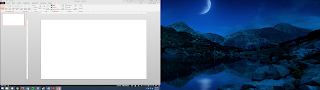
Draw a line down the center. Go to the Insert Tab, and click Shapes. Choose the Line or the Line with an arrow and draw your center line.
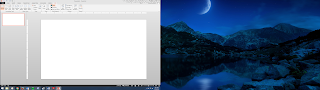
Then, draw two more lines on each side dividing them equally making four equal sections.

Next, insert text boxes into one section and design your bookmark. Use clip art and students won’t need to cite sources. Copy and paste your bookmark into the other sections, or design each bookmark to be different.

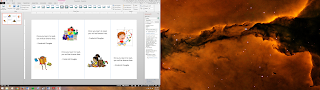
I like to print them onto cardstock and then cut them apart on the lines. This is a good idea for book reports, too. Students can make bookmarks to encourage others to read the book they read.
At times a book I read has a recipe in it and I am usually asked for the recipe since only one student can check out the book. I have put the recipe on bookmarks for students to take. What information do your students need to study? Make a bookmark or have them make one.
If you want double-sided bookmarks, just add a second slide divided in exactly the same place, create your second side and print it double-sided.
I hope you enjoy this creative idea and also an extra day this year. Happy Leap Year Day!
Audrey
I like to have bookmarks on hand for the students to take when they come to the library. It can get costly, though. Tammy Worcester gave a presentation at a conference and one of the ideas was how to make your own bookmarks using Powerpoint slides.
Open up Powerpoint and change the slide to a blank slide. (Enjoy the pictures on the side. I have dual monitors and when I capture a screen shot, it also captures the second monitor picture.)

Next, click and turn on the ruler option. Mine looks like this. I went to the View tab and clicked Ruler.

Draw a line down the center. Go to the Insert Tab, and click Shapes. Choose the Line or the Line with an arrow and draw your center line.

Then, draw two more lines on each side dividing them equally making four equal sections.

Next, insert text boxes into one section and design your bookmark. Use clip art and students won’t need to cite sources. Copy and paste your bookmark into the other sections, or design each bookmark to be different.


I like to print them onto cardstock and then cut them apart on the lines. This is a good idea for book reports, too. Students can make bookmarks to encourage others to read the book they read.
At times a book I read has a recipe in it and I am usually asked for the recipe since only one student can check out the book. I have put the recipe on bookmarks for students to take. What information do your students need to study? Make a bookmark or have them make one.
If you want double-sided bookmarks, just add a second slide divided in exactly the same place, create your second side and print it double-sided.
I hope you enjoy this creative idea and also an extra day this year. Happy Leap Year Day!
Audrey
Subscribe to:
Posts (Atom)