This is the help page for Adventist librarians, particularly those who live and work in the North Pacific Union. Audrey Campbell is your Resource Librarian and is available to respond to your questions and comments.
Tuesday, November 27, 2012
Christmas in the Library
Greetings!
I hope you got some much needed rest over the short Thanksgiving break. Now we turn quickly to the coming Christmas holiday. I will tell you a secret. I don’t really like decorating for Christmas. I have a large space and it is full of books and shelves and tables and adding even more stuff in there looks cluttered at times. Plus it only lasts for a couple of weeks, so it seems like a waste of time.
HOWEVER – I do decorate for the following reasons.
1. The children love to come in and see the Christmas decorations.
2. It makes the library look inviting and festive.
3. I have helpers to put it up and take it down!
I haven’t really started much decorating yet, but we will put our library tree (artificial) up today. And that brings me to my post for this week. I have a contest going. Students who wish to enter the contest can make an ornament for the library Christmas tree. They need to make or decorate an ornament that fits the theme of Books and Reading. Their ornament needs to have a tag with two things on the tag – the title of the book the ornament represents and the student’s full name. These ornaments are due next week and winners will be chosen from each grade level. The ornaments will be theirs to keep and they can take them home just before vacation.
Two years ago I did this same contest and got exactly 12 ornaments. All from grades 3 and under. My intention was to choose three from each wing which would have been 12 in all, so I just declared each of them winners. I gave them a gift certificate for a book from the Scholastic Book Fair that would come in the spring and one of our teachers who is a wonderful photographer took their pictures which we made into posters and put up on the empty wall above the stacks. All in all it was a success. This time I made the change to specify that the ornament must have a tag with the name of the book on it because one ornament looked like a bead string and I simply could not guess what book it was supposed to represent!
Wouldn’t this be a great idea for a classroom to do a book report ornament? They could make an ornament to represent the book they read, tell about it in class and then hang it on the tree. Or you could keep track of the books they read over the next few weeks. They can hang an ornament for each book they read.
Here are the posters we made and put on the wall. Each student is holding a favorite book similar to the posters that ALA Graphics puts out. These posters are 16 inches by 24 inches, so they really are fairly large, but look much smaller up high. Keep that in mind if you decide to do something like this.
Well, I need to go pull down my Christmas decorations and get started or the holiday (at school) will be over before I get going!
I hope you have a great week. Take your vitamins! You will need the energy.
Audrey
Monday, November 19, 2012
Andrew Clements books
Greetings!
I just read the newest Andrew Clements book called About Average. Jordan is in sixth grade and is neither tall nor short, not blond nor brunette, not fat, nor thin – but average. Her grades are average. She sings OK, but is not good enough to have a solo. It seems to Jordan that others in her class are much more talented than she it.
Jordan has a crush on a boy but this does not take over the story. She also is a really nice girl and I love how she handles a bullying situation when it occurs. Jordan throws away some papers and one of the girls finds them and then begins to read them aloud with exaggerated expression to make fun of Jordan. Jordan thinks and decides that no matter what that girl does to her, she will be nice. My first thought was that Jordan was heaping coals of fire on the girl’s head, but that term was not mentioned.
Jordan does eventually do something that is above average near the end of her sixth grade year. She performs a heroic act when a tornado comes and the orchestra director is knocked unconscious. She quickly organizes the students to action and they take refuge under the grand piano surrounded by music stands and covered with the velvet curtains from the stage.
Andrew Clements is a good writer and his books are very popular. He always has a lesson buried in the story so it doesn’t sound preachy. If you don’t’ have any of his books AND you are in an elementary school, I would strongly suggest you purchase some of them. The ones I suggest you purchase are:
Frindle
Trouble-Maker
No Talking
Lunch Money
The Report Card
The School Story
Lost and Found
Extra Credit
A Week in the Woods
The Landry News
The Last Holiday Concert
Room One: A Mystery or Two
The Janitor’s Boy
The Jacket
You might want to stay away from Things Not Seen, Things Hoped For, and Things that Are. Even though the titles sound a bit religious, they are not. Read the blurbs or the books before you decide to put it in your library. I have chosen not to put them in ours.
I hope you have a great Thanksgiving vacation. I’ll be in Seattle visiting my son. I’m looking forward to the break.
Audrey
Monday, November 12, 2012
Books for your Library
Greetings!
This week I have some more books to interest you. I just pulled some random titles off my cart. There is no theme here, just books that I think will be good additions to an elementary school library.
Mrs. Harkness and the Panda by Alicia Potter is about a real person and how she and her expedition team braved the odds to bring the first panda, Su Lin, to the United States in 1936. There is a timeline, an author’s note and photographs to support the watercolor drawings of the story.
If your school is like ours, you have students who love Legos. We have a few Lego books and they never seem to be on the shelf very long. Here is a new one published in 2011 with ideas from Lego fans. I have a feeling that I should have bought more than one copy! The Legos Idea Book.
It’s difficult for children to understand about chronic illness. When Pete’s Dad Got Sick by Kathleen Long Bostrom is a great way to open up the conversation for children and families. The book is written from a Christian perspective and Pete asks his dad why God would give him fast legs, then take them away. His father replies that God didn’t take them away. Sometimes people get sick or hurt. He continues to trust that God wants what is best for us and claims the Bible promise “I can do everything by the power of Christ.” The illustrations are realistic drawings. At the end of the story are a few pages of parental helps from a clinical psychologist. This is one of the books from the series Helping Kids Heal published by Zonderkidz.
Do you have a student with autism? My Friend Has Autism by Amanda Doering Tourville helps explain in a simple way what a child with autism may act like and how students can understand more about them and the disorder. On certain pages a box titled “Did You Know?” gives more information about the characteristic described on that page to help further understanding.
We have a young student that loves Poison Dart Frogs and when I saw this book in a preview box, I had to get it. The Life Cycle of a Poison Dart Frog by Anna Kingston shows the wide variety of these frogs and the bright colors they have. It is truly a beautiful book. I love that the illustrations are photographs rather than drawings.
Bird Talk by Lita Judge is subtitled What Birds are Saying and Why. Twenty-eight different birds are mentioned and what their calls and actions mean. One example is the North American Killdeer who feigns a broken wing to attract enemies away from her eggs. The author’s lovely realistic pen and watercolor illustrations support the text.
I hope you have a great week.
Audrey
Tuesday, November 6, 2012
Holiday Books
Greetings!
The holidays are fast approaching and will be here before we can turn around. Pull out your holiday books and decide what you want to read to the students and what you can put on a display. I pull out the books that I am planning to read aloud weeks before so they can’t get their hands on them and I know they will be ready for my lesson.
Here are a few that I love to share with the kids.
If your kids watch the Macy’s Thanksgiving Day parade, read this book to them about how the balloons of the parade began. This is the true story of the man behind the balloons – a puppeteer named Tony Sarg. I didn’t know that the reason the puppet/balloons began was because Macy’s put live animals in the parade which frightened the children. So they asked Tony to think of something spectacular. As we all know, he certainly did. Read Balloons Over Broadway by Melissa Sweet.
Emily Arnold McCully writes a great story and has taken an incident from history and embellished it. Butch Cassidy and the Sundance Kid along with some other outlaws hosted a Thanksgiving banquet at Browns’ Hole, Utah. McCully has taken Ann Bassett’s account of this banquet and has added two fictional guests to the table. All ages will enjoy this exciting story about the Wild West and outlaws. Read An Outlaw Thanksgiving by Emily Arnold McCully.
Cranberry Thanksgiving written by Wende and Harry Devlin is a story about a little girl named Maggie and her grandmother who has a secret recipe for cranberry bread. Maggie invites the scruffy, uncouth neighbor, Mr. Whiskers, for Thanksgiving dinner even though Grandmother does not like him or trust him. Grandmother has invited a handsome stranger from the town who is quite dapper. Of course, the handsome stranger ends up being the one who is trying to steal the secret recipe and Mr. Whiskers saves the day. I plan to make some cranberry bread from the recipe in the back of the book and have small pieces for the students to taste when I read this one. If your kids like this story, read Cranberry Christmas. Mr. Whiskers’ sister is coming to visit and to take him back with her because she thinks he can’t take care of himself properly. Also, a mean neighbor, Cyrus Grape won’t let anyone skate on his pond and all the children are unhappy about it. Things work out so that Mr. Whiskers doesn’t have to move away and the children get to skate on the pond after all. Included is a recipe for cranberry cookies, too.
If you like books where you can share a treat, you’ll love The Legend of the Candy Cane by Lori Walburg. We have used this book a couple of times in our school assembly near Christmas and at the end all the kids get a miniature candy cane. The candy cane can be turned curved end down to make a ‘J’ for Jesus, the curved end up to make a staff to remind us that the shepherds were the first to learn of Jesus’ birth, and red stripe to remind us that ‘by His stripes we are healed’. The illustrations by James Bernardin are lovely paintings that add richness to the story.
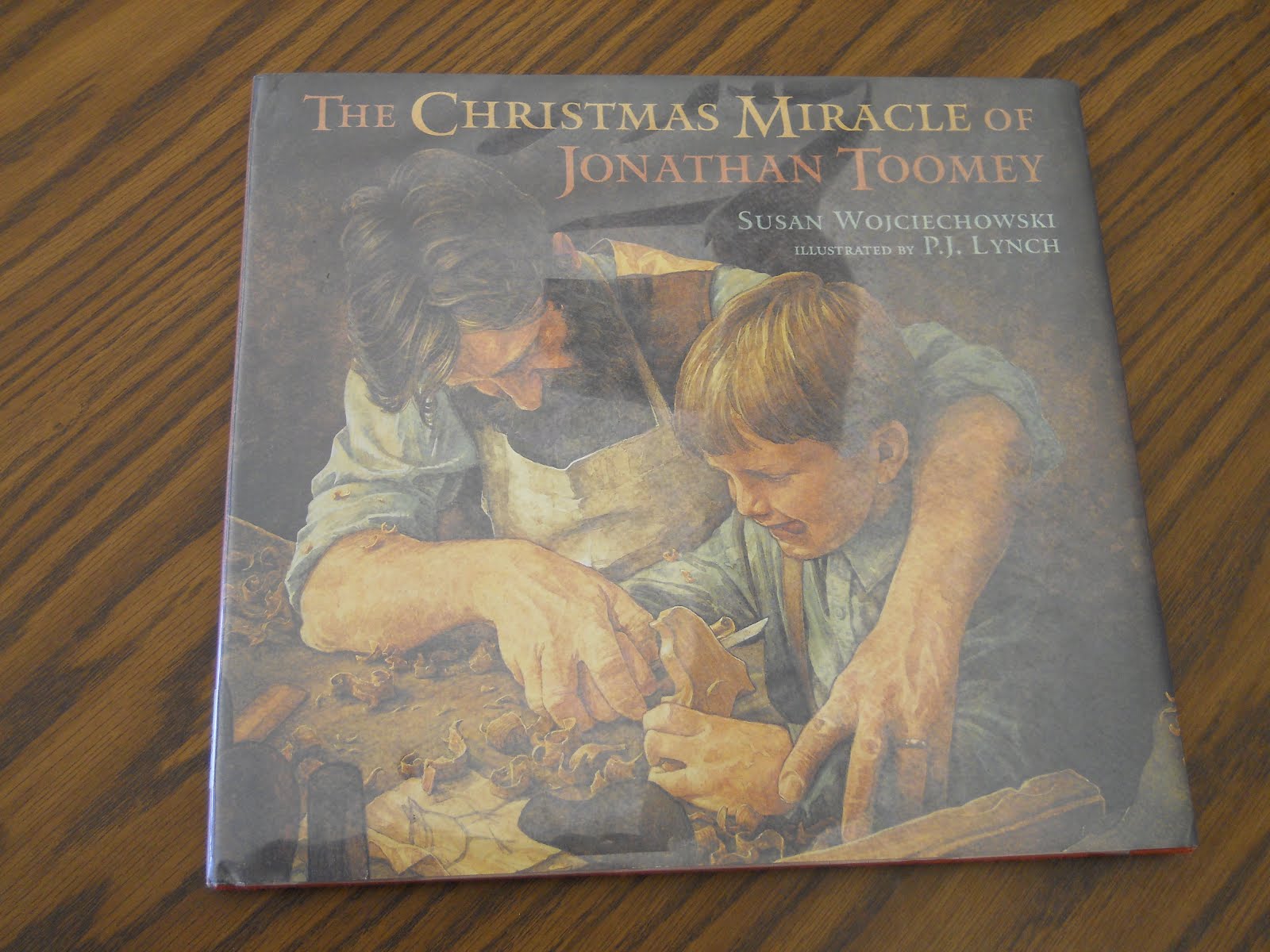
The Christmas Miracle of Jonathan Toomey by Susan Wojciechowski and illustrated by P. J. Lynch is another beautiful book . A widow commissions a gruf and gloomy wood carver to replace a crèche which had been lost. She requests that her son be allowed to watch the carver as he works. The wood carver lives a hermit-like life and doesn’t want to be friendly, but as the days and weeks progress, he slowly puts his personal sorrow aside and lets the friendliness of the child and his mother bring warmth to his cold heart. There is a movie made from this book that is really special, too.
Do you have a favorite Thanksgiving or Christmas story that you would like to share with other teachers through this post? Send me the information and I’ll be glad to pass this along.
Have a great week.
Audrey
Monday, October 29, 2012
Book Swap
Hello,
I’ve mentioned the idea of having a Book Swap previously, but it has been a while and I thought you might not mind a repeat. One student came to me at the first of the year and asked if we were going to have a book swap this year. We talked about it and his recommendation was to have two book swaps; one in December and another one again in May. I told him that he had a good idea and to remind me about it the first of November. This morning he came to my desk, and reminded me. I guess it is close enough to the first of November to remind me, so I thanked him and he went on his way.
Here’s what I do when I have a book swap.
A few weeks before the swap I make an announcement letting students and parents know about the swap, what kind of books to bring, and what to expect. I put this in our newsletter and I put up posters around the school. I also announce it during library classes for a week or two before the swap.
I hold the Book Swap for only one day and a Wednesday works best for me. I don’t have it on Thursday or Friday since that would interfere with my library classes. Students bring their books to swap on the Monday and Tuesday just before the swap and I give them a ticket for each book they bring. The first year I carefully checked each book as it was brought in and would not give any tickets for books that did not fit the guidelines. I didn’t have too many, but the disappointed faces I saw were too much for me. I now don’t worry about subject matter or condition of the book; I just give them a ticket for each book. The reason I don’t mention subject matter or condition is because I don’t want any student to feel hurt or upset. Later, I weed out any inappropriate books and quietly dispose of the few that may show up. I have extra books that I put in the swap which help make up the difference. I print out tickets as needed so I don’t waste paper. You can easily make your own ticket.
I put twelve tickets on one sheet of paper and cut off the amount a student needs. Students are responsible for their own tickets and if they lose them, that is unfortunate. I recommend they keep them in their desks or lockers so they will be here for the swap.
Only students with tickets are allowed into the swap until after the lunch period is over. Then, any student may come through and ‘buy’ books either with a ticket or for the nominal price of 10 cents each. Money goes to the library. After the school day is over, any books left over belong to the library for me to do with what I want.
On the day of the swap, I let the older students come through first. I learned this reading about another swap at a school. That school’s first swap had the younger students coming through and choosing thick novels that were appropriate for the older students and by the time the older kids came to the swap, only younger picture books were left. They changed the order the next year and their swap went much better.
If you have any questions, please let me know. I hope you decide to have a book swap and that it is fun for you and your students.
Have a great week.
Audrey
Monday, October 22, 2012
Library Displays
Greetings!
Do you pull out books for displays in your classroom or your library? If you don’t, why not? It is a great way to get some books noticed. You can use the top of the shelves, a table, a desk, a box, a bathtub, or anything that will hold some books. Use a crate or bookends to help books stand upright.
We have a display in our library right now on bears. We have informational books and stories about bears from all sections of the library. We have stuffed bears on the tables and shelves to supplement the display. It has been great and the children are enjoying the books.
We used a Paddington Bear and a Smokey bear along with a Winnie the Pooh to bring attention to stories about each of them.
The center of the table has the tallest books. You can also cover a box with a tablecloth and put books on the box to give them height.
This swing has been in the library for years.
We have a panda lover on our team and a part of her collection is prominently displayed. A number of our panda books were near this, but were promptly checked out.
The child-sized chair was donated to our library a couple of years ago and all ages love to sit in it.
We have another display on survival and have pulled both stories and information for this, as well.
I bought a number of these Lucite signs at Staples and a piece of regular paper fits in there well. We put a piece of construction paper in to give some color and draw attention to the display.
This set of books called “Survive Alive” by Neil Champion is a great addition to your library. There are three more in the series that aren’t shown in the picture: Finding Food and Water, In An Emergency, and Tools and Crafts.
Look at the calendar for ideas for displays. Pull books for the major holidays and the minor ones as well. When National Popcorn Day (January 19) comes around, pull books on corn, popcorn, and cookbooks with popcorn recipes in it. Make bookmarks with a flavored popcorn recipe on it for the students to take home. If you google “national popcorn day”, you will also find fun activities to do. You can find oodles of ideas on the internet.
Don’t forget school subjects, too. What are you teaching that can be supplemented from the library? If you are a classroom teacher, check out books for a display in your classroom.
Display books by color or size. Check with your students for props to borrow to enhance the displays. Pick and choose the displays you want to do. Have students help hunt for books that fit the theme of the display. If they find the books, they might also actually read them. Have a goal for one display a month and have the display last for a week or two unless it is so popular you decide to keep it up. No display in between will also promote interest when a new display goes up.
I hope these ideas have spurred your interest in putting up some displays in your school. Send ideas and pictures so I can see what talented readers I have.
Have a great week.
Audrey
Thursday, October 11, 2012
Read Alouds, part 3
Greetings,
I will continue my previous two posts regarding books to read aloud.
Suzy Kline writes some great stories. She was a third grade teacher and her students were trying to find chapter books that they could read on their own. She started writing a series about Horrible Harry geared for readers in about second grade. But that’s not the series I want to tell you about. Herbie Jones is a third grader and the funniest things happen to him. Kids love to hear about his adventures. Try the one where he is invited to Annabelle’s birthday party and takes a can of salmon as a gift. Then make sure you have others in your library in the series including Herbie Jones and the Class Gift, and Herbie Jones and Hamburger Head.
You probably know Beverly Cleary best for her books about Ramona Quimby. All of Beverly Cleary’s books are great read alouds, but she has other books that are maybe not as well known. Dear Mr. Henshaw is a favorite of mine and I love this gentle story told in letter/diary format. Leigh writes to an author as a second grader and again in third and fourth grades. When Leigh is in sixth grade, his parents divorce, he and his mother move, and Leigh ends up writing a diary and we learn how he adjusts to his new life and how he comes to terms with his absent father. There is a sequel to this story also called Strider.
You may know Robert McCloskey for his famous book, Make Way for Ducklings. This man has a tremendous sense of humor which shows up in his books. Take Homer Price – extra ordinary things just seem to happen to an ordinary boy who has a pet skunk and an uncle who owns the town’s donut machine. After this book, you can read more stories about Homer Price in Centerburg Tales. These two books are a collection of stories. Each story is fairly long and may need two or even three days for reading each story.
If you like Homer Price, you may also like the set of books by Bertrand R. Brinley called The Mad Scientists Club. A group of boys aged 12 – 15 call themselves the Mad Scientists Club. They hatch up some wild plans among themselves and try to hatch a dinosaur egg, build a sea monster on their canoe that fools the people across the lake, find something hidden inside the cannon on the town square, and much more. Granted, the stories were written in the 1960s, and the technology is old fashioned, but the stories are still fun to read. I hope some of you know about these books, but I would guess that most of you have not. There are three other books in the series. The New Adventures of The Mad Scientists Club, The Big Kerplop, and The Big Chunk of Ice. Enjoy.
It looks like this week has a little theme of books that are old fashioned. One of my very favorites is Understood Betsy by Dorothy Canfield Fisher. Elizabeth is being raised by an overprotective aunt who has very specific ideas on child raising. Circumstances arise that send Elizabeth to live on a farm with other relatives who call her Betsy instead of Elizabeth. Betsy learns to be independent and to think for herself and I cheer for her as she begins to grow up. One thing I love about this book is that Elizabeth is first referred to as Elizabeth, and at some point in the story, she is then called Betsy rather than Elizabeth. Elizabeth is the frightened dependant child, and as she becomes more independent, her personality and name changes. This would be a great book to read aloud and ask the children about the name change. The book is in print, but I got it free on my Kindle.
Robert Burch wrote a book called Ida Early Comes Over the Mountain, a story about a woman who cares for the children in a family. The children’s mother had died and a stern aunt is caring for the family. Ida is tall and not very attractive, but the children grow to love her and the fun she brings with her. A sequel to this book is Christmas With Ida Early.
If you like Ida Early, you will probably like The Year of Miss Agnes, too. A small school in Alaska has a hard time keeping teachers. Life is very hard and no one seems to want to stay around. When Miss Agnes comes along, the children expect she will be the same as the others and leave as soon as she can, but Miss Agnes surprises them all. She throws away old textbooks (Yea!) and reads exciting books to them. The children start to enjoy their lessons and are learning, but keep wondering if Miss Agnes will leave or stay.
Ruth Redding Brand loves to write Bible stories for children. Charles Mills loves to write for children. Together they have written a series of books that your children will love. Call them either Amazing Stories from the Bible or the Professor Appleby and Maggie B tapes series; it doesn’t matter. They are fun and the students will beg for more. Other titles are Miracle Stories from the Bible, Heroic Stories from the Bible, Adventure Stories from the Bible, Mysterious Stories from the Bible, and Miracle Stories from the Bible. If you are going to read these aloud, it would be helpful to read them in order.
I hope you have enjoyed these read aloud ideas. Maybe we’ll do some more later in the year.
Have a great week,
Audrey
Subscribe to:
Posts (Atom)