Greetings!
This past fall I took an online course from Google called Power Searching. The course teaches some tips and tricks to searching for material on the internet. Some of what was taught I knew, but I learned a lot of useful information and some things that were just plain cool! I had a great time, learned a lot, and was able to do this somewhat at my own pace. The course lasted for two weeks and the lessons needed to be completed in that time slot. At the end of the course when I completed the coursework, I received a certificate from Google.
Here is some of what I learned in the course.
1. Weather: If you want to know what the weather is somewhere, type “weather Portland, OR” or “weather London” and press ENTER. You will then see the weather for the next 5 days.
2. Calculator: type a calculation and press ENTER. You will see the answer in the results window.
3. Google Images: You can filter the results by using the sidebar information. If you want pictures of red frogs, click on the red square. If you want line drawings to use for a coloring page, you can do this, also.
The whole course was really interesting and took only about 10 – 12 hours. I really learned a lot of stuff and then, because I am a teacher, I wanted to share it with everyone. Plus, it is FREE! Plus, educators in the North Pacific Union Conference can count this for clock hours if you keep track of the time you spend on the course. Plus, you can do it at your own rate. A fun course that is FREE where I can get technology clock hours is worth a few hours of my time and I thought that many of you might feel the same way. And did I mention that it is FREE?!
So here you go. Go to www.powersearchingwithgoogle.com and scroll down a bit. You will see two courses. The top one says “Advanced Power Searching” and the lower one says “Power Searching”.
The Power Searching course is the one that I took in the fall. The lessons were revealed a few at a time during the two week period for the class. For each part of the lesson I watched a short video and completed an activity. Each lesson had multiple videos/activities for different parts of the lesson. Each video was less than 10 minutes and the activities were fun and interesting. I could stop any at any point in the lesson and return later to complete it. There were opportunities to communicate with others taking the course from all over the world. I did not choose to do this. Now the Power Searching course is self paced. There are six lessons and each took me approximately 50 minutes to an hour to complete.
The Advanced course begins on January 23, 2013 and you can sign up to take this class. I would imagine it is similar to the Power Searching course I took. Even though this is ‘timed’ it is still self paced during the two weeks the course lasts.
I hope some of you take advantage of the Google Power Searching course or courses. I showed some of the techniques I learned to our faculty in a staff meeting and got a lot of ‘Ooohs’ and ‘Ahhhs’ which was really fun.
I hope you have a great week.
Audrey
Monday, January 14, 2013

Monday, January 7, 2013
Plagiarism
Greetings!
I hope you all had a good vacation and are ready to tackle the next half of the school year.
I am giving library and study skills lessons to the students in grades 5 – 8 and last week I talked about plagiarism. I gave a definition of plagiarism and mentioned that the word comes from the Latin word for “kidnap” which is a good way to explain this to kids.
I also talked to them about how teachers can tell if you have copied and pasted.
1. It is usually obvious.
2. Teachers suspect if there are words in the selection that students do not normally use.
3. Sources can be quickly checked.
One student mentioned that it is OK as long as you cite your sources. But I told them that this is still not OK. They DO need to cite sources, but they also need to put things in their own words. Then, I gave a little demo of how to paraphrase.
First I found a short paragraph in the internet.
“An earthquake is the shaking of the ground caused by an abrupt shift of rock along a fracture in the Earth, called a fault. Within seconds, an earthquake releases stress that has slowly accumulated within the rock, sometimes over hundreds of years.”
Then I highlighted (shown in bold below) the words and phrases that are unlikely for students to be using. Your students can most likely help you find these, too.
“An earthquake is the shaking of the ground caused by an abrupt shift of rock along a fracture in the Earth, called a fault. Within seconds, an earthquake releases stress that has slowly accumulated within the rock, sometimes over hundreds of years.”
Next, I made small changes to the paragraph.
Paraphrase (Not acceptable)
An earthquake is the shaking of the ground caused by a shift of rock along a fracture in the Earth called a fault. In seconds an earthquake lets go of stress that has slowly happened inside the rock, sometimes over hundreds of years.
The parts that are in bold lettering are the parts that are not changed and still copied and plagiarized. The students can see immediately that not much has changed and understand that the paragraph is still not in their own words.
I then showed them how to take simple notes on the paragraph.
Notes:
Earthquake – shaking of the ground
Causes – sudden movements of the rock, fault line moves,
Stress builds up in the rocks over long periods of time
Finally I showed them a paragraph rewritten in my own words and an acceptable paraphrase.
Paraphrase (Acceptable)
When the ground suddenly starts shaking, you know an earthquake is happening. This is caused by the sudden movements of the rocks near a fault line. Over long periods of time stress builds up in the rocks and when they move, the ground shakes.
If I were doing this in a classroom setting rather than a 15 minute library lesson period, I would have the students help with each part, and I would also do this with a few paragraphs until I felt that the students had the idea.
Please feel free to use my sample in your lessons if you would like to. I believe that it is important to teach this in elementary school. Somehow I never got this lesson. Teachers would tell us to put it in our own words, but I really didn’t understand until much later.
Have a great week.
Audrey
Monday, December 10, 2012
Christmas Ornament Contest
Greetings!
I told you about my ornament contest a few weeks ago. Students who wanted to enter the contest could make an ornament for the library Christmas tree. The directions were to make or decorate an ornament that fits the theme of Books and Reading. Well, last week I got the ornaments in and had only twelve students enter. All the entries were from grades 5 and under. I thought you might like to see the entries I got. A few were quite clever.


I hope you have a wonderful holiday.
Audrey
I told you about my ornament contest a few weeks ago. Students who wanted to enter the contest could make an ornament for the library Christmas tree. The directions were to make or decorate an ornament that fits the theme of Books and Reading. Well, last week I got the ornaments in and had only twelve students enter. All the entries were from grades 5 and under. I thought you might like to see the entries I got. A few were quite clever.


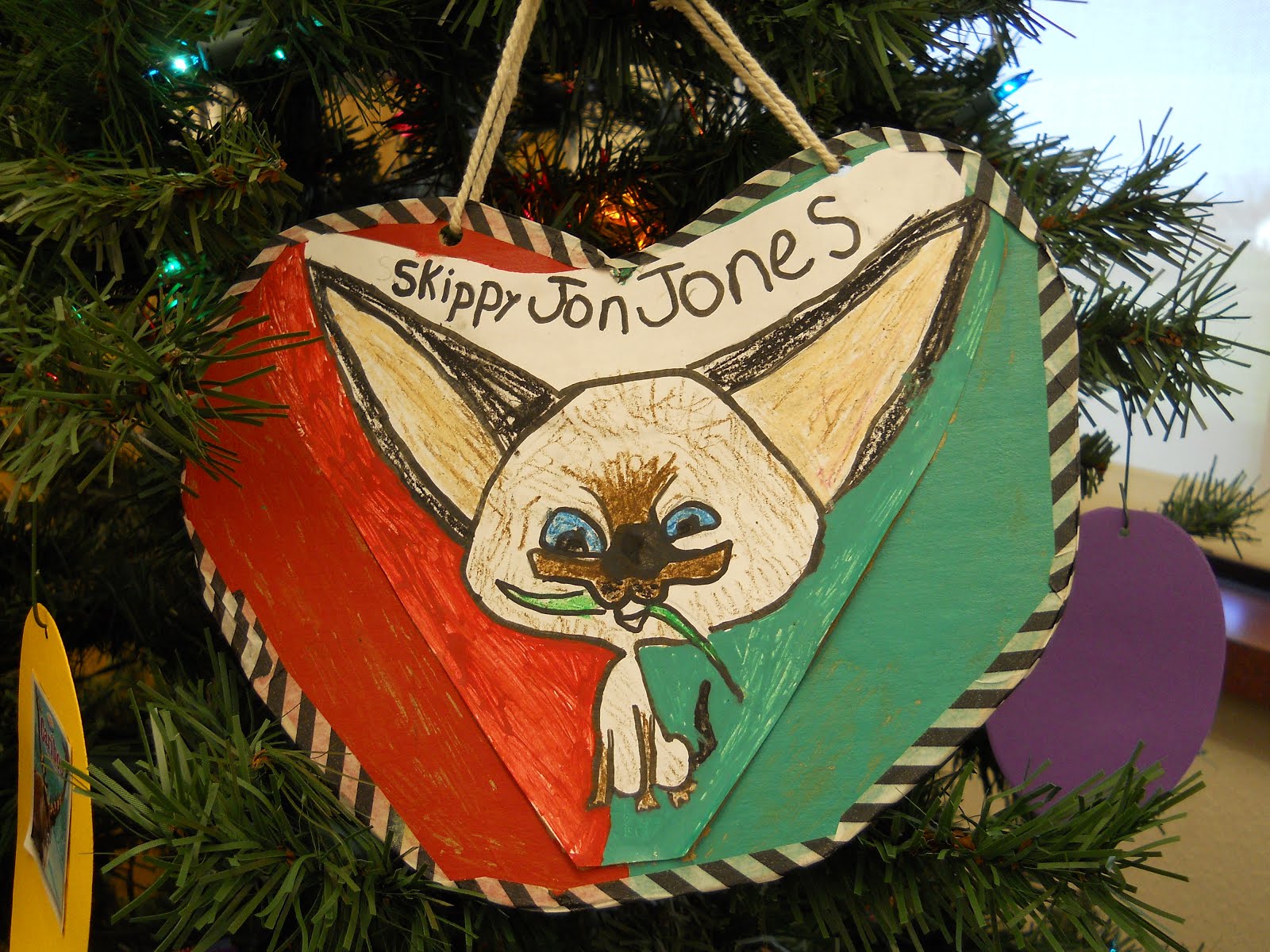


I hope you have a wonderful holiday.
Audrey
Tuesday, December 4, 2012
Christmas Display
Greetings!
This is the time of year to pull out all your Christmas books and make a great display. Put them in like categories and display them together. For example, put all the ones about Jesus’ birth together with a small Nativity set. You can put a small Christmas tree on a table and books about Christmas trees or even just trees around it.
Maybe you have a lot of books by one author such as Patricia Polacco. Find a photo of the author on Google Images, (don’t forget to copy the source ) print it out and put it in a Lucite frame or laminate it so students can know what the author looks like. You can also put some biographical information there, too. This helps students realize that authors are real people.
Even with a wide variety of Christmas books, you can still put some kind of Christmas decoration or even just some garland around the books. If you put some snowmen around, you can even leave those up for a month or so afterwards! (I told you that I do not like to decorate!)
I hope you have a great week. Don’t overdo or you’ll get sick.
Audrey
Tuesday, November 27, 2012
Christmas in the Library
Greetings!
I hope you got some much needed rest over the short Thanksgiving break. Now we turn quickly to the coming Christmas holiday. I will tell you a secret. I don’t really like decorating for Christmas. I have a large space and it is full of books and shelves and tables and adding even more stuff in there looks cluttered at times. Plus it only lasts for a couple of weeks, so it seems like a waste of time.
HOWEVER – I do decorate for the following reasons.
1. The children love to come in and see the Christmas decorations.
2. It makes the library look inviting and festive.
3. I have helpers to put it up and take it down!
I haven’t really started much decorating yet, but we will put our library tree (artificial) up today. And that brings me to my post for this week. I have a contest going. Students who wish to enter the contest can make an ornament for the library Christmas tree. They need to make or decorate an ornament that fits the theme of Books and Reading. Their ornament needs to have a tag with two things on the tag – the title of the book the ornament represents and the student’s full name. These ornaments are due next week and winners will be chosen from each grade level. The ornaments will be theirs to keep and they can take them home just before vacation.
Two years ago I did this same contest and got exactly 12 ornaments. All from grades 3 and under. My intention was to choose three from each wing which would have been 12 in all, so I just declared each of them winners. I gave them a gift certificate for a book from the Scholastic Book Fair that would come in the spring and one of our teachers who is a wonderful photographer took their pictures which we made into posters and put up on the empty wall above the stacks. All in all it was a success. This time I made the change to specify that the ornament must have a tag with the name of the book on it because one ornament looked like a bead string and I simply could not guess what book it was supposed to represent!
Wouldn’t this be a great idea for a classroom to do a book report ornament? They could make an ornament to represent the book they read, tell about it in class and then hang it on the tree. Or you could keep track of the books they read over the next few weeks. They can hang an ornament for each book they read.
Here are the posters we made and put on the wall. Each student is holding a favorite book similar to the posters that ALA Graphics puts out. These posters are 16 inches by 24 inches, so they really are fairly large, but look much smaller up high. Keep that in mind if you decide to do something like this.


Well, I need to go pull down my Christmas decorations and get started or the holiday (at school) will be over before I get going!
I hope you have a great week. Take your vitamins! You will need the energy.
Audrey
Monday, November 19, 2012
Andrew Clements books
Greetings!
I just read the newest Andrew Clements book called About Average. Jordan is in sixth grade and is neither tall nor short, not blond nor brunette, not fat, nor thin – but average. Her grades are average. She sings OK, but is not good enough to have a solo. It seems to Jordan that others in her class are much more talented than she it.
Jordan has a crush on a boy but this does not take over the story. She also is a really nice girl and I love how she handles a bullying situation when it occurs. Jordan throws away some papers and one of the girls finds them and then begins to read them aloud with exaggerated expression to make fun of Jordan. Jordan thinks and decides that no matter what that girl does to her, she will be nice. My first thought was that Jordan was heaping coals of fire on the girl’s head, but that term was not mentioned.
Jordan does eventually do something that is above average near the end of her sixth grade year. She performs a heroic act when a tornado comes and the orchestra director is knocked unconscious. She quickly organizes the students to action and they take refuge under the grand piano surrounded by music stands and covered with the velvet curtains from the stage.
Andrew Clements is a good writer and his books are very popular. He always has a lesson buried in the story so it doesn’t sound preachy. If you don’t’ have any of his books AND you are in an elementary school, I would strongly suggest you purchase some of them. The ones I suggest you purchase are:
Frindle
Trouble-Maker
No Talking
Lunch Money
The Report Card
The School Story
Lost and Found
Extra Credit
A Week in the Woods
The Landry News
The Last Holiday Concert
Room One: A Mystery or Two
The Janitor’s Boy
The Jacket
You might want to stay away from Things Not Seen, Things Hoped For, and Things that Are. Even though the titles sound a bit religious, they are not. Read the blurbs or the books before you decide to put it in your library. I have chosen not to put them in ours.
I hope you have a great Thanksgiving vacation. I’ll be in Seattle visiting my son. I’m looking forward to the break.
Audrey
Monday, November 12, 2012
Books for your Library
Greetings!
This week I have some more books to interest you. I just pulled some random titles off my cart. There is no theme here, just books that I think will be good additions to an elementary school library.
Mrs. Harkness and the Panda by Alicia Potter is about a real person and how she and her expedition team braved the odds to bring the first panda, Su Lin, to the United States in 1936. There is a timeline, an author’s note and photographs to support the watercolor drawings of the story.

If your school is like ours, you have students who love Legos. We have a few Lego books and they never seem to be on the shelf very long. Here is a new one published in 2011 with ideas from Lego fans. I have a feeling that I should have bought more than one copy! The Legos Idea Book.

It’s difficult for children to understand about chronic illness. When Pete’s Dad Got Sick by Kathleen Long Bostrom is a great way to open up the conversation for children and families. The book is written from a Christian perspective and Pete asks his dad why God would give him fast legs, then take them away. His father replies that God didn’t take them away. Sometimes people get sick or hurt. He continues to trust that God wants what is best for us and claims the Bible promise “I can do everything by the power of Christ.” The illustrations are realistic drawings. At the end of the story are a few pages of parental helps from a clinical psychologist. This is one of the books from the series Helping Kids Heal published by Zonderkidz.

Do you have a student with autism? My Friend Has Autism by Amanda Doering Tourville helps explain in a simple way what a child with autism may act like and how students can understand more about them and the disorder. On certain pages a box titled “Did You Know?” gives more information about the characteristic described on that page to help further understanding.

We have a young student that loves Poison Dart Frogs and when I saw this book in a preview box, I had to get it. The Life Cycle of a Poison Dart Frog by Anna Kingston shows the wide variety of these frogs and the bright colors they have. It is truly a beautiful book. I love that the illustrations are photographs rather than drawings.

Bird Talk by Lita Judge is subtitled What Birds are Saying and Why. Twenty-eight different birds are mentioned and what their calls and actions mean. One example is the North American Killdeer who feigns a broken wing to attract enemies away from her eggs. The author’s lovely realistic pen and watercolor illustrations support the text.

I hope you have a great week.
Audrey
Subscribe to:
Posts (Atom)